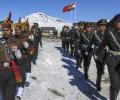
The decision to disengage the forces, locked in a bitter standoff for the last six weeks in eastern Ladakh, was taken at a nearly 11-hour-long meeting between senior Indian and Chinese commanders in Moldo on the Chinese side of the Line of Actual Control (LAC) on Monday.
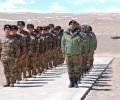
The sources said both sides held extensive deliberations on modalities for disengagement of troops from all the friction points in eastern Ladakh at the talks.

India has already mobilised fighter jets and sent thousands of additional army troops to forward locations along the border with China after 20 Indian Army personnel were killed in a brutal attack by Chinese troops in eastern Ladakh's Galwan Valley on June 15.

Singh also said that Indian troops are standing firm braving extreme weather and hostile forces to defend the country's territorial integrity.

The meeting came after the Indian Army thwarted an attempt by the Chinese Army to transgress into Indian areas near the southern bank of Pangong Tso near Chushul in Ladakh on the intervening night of Saturday and Sunday.

After a gap of over two-and-half months, India and China on Sunday held the ninth round of military talks specifically focusing on ways to move forward on the long-negotiated disengagement process in eastern Ladakh as thousands of their troops remained deployed at friction points under freezing conditions.

The two sides have also agreed for a joint mechanism to verify the progress in the disengagement process through delegation meetings as well as using unmanned aerial vehicles.

The Army said it was also highlighted that completion of disengagement in other areas would pave the way for the two sides to consider de-escalation of forces and ensure full restoration of peace and tranquillity and enable progress in bilateral relations.

"I am not aware of the information you provided," Chinese foreign ministry spokesman Zhao Lijian said in Beijing when asked about the reports of the Indian casualties at the contested borders. "Our border troops had a high-level meeting and reached important consensus on easing the border situation but astonishingly, on June 15, the Indian troops seriously violated our consensus and twice crossed the border line for illegal activities and provoked and attacked Chinese personnel which led to serious physical conflict between the two sides and China has lodged strong protest and representation with the Indian side," Zhao said.
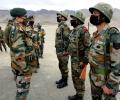
The seventh round of military talks between India and China held on Monday was "positive and constructive", and both sides agreed to earnestly implement the understanding reached by their leaders to not turn differences into disputes, a joint statement by the two armies said on Tuesday.

The commanders will also deliberate on a slew of long-pending reform measures like cutting down on ceremonial practices and non-military activities to ensure a rational distribution of resources, they said.

In the review meeting, Singh told the top military brass to continue to deal with the situation in eastern Ladakh and other areas with "firmness".
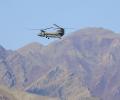
As soon as one lands at the Leh airfield, one can see the Indian Air Force C-17s, Ilyushin-76s, and C-130J Super Hercules aircraft flying in with rations and supplies for the troops deployed on the forward locations opposite the Chinese forces.

The first firing which killed six civilians, occurred when army personnel mistook coal mine workers returning home in a pick-up van singing songs on Saturday evening, to be insurgents belonging to the Yung Aung faction of the banned outfit National Socialist Council of Nagaland-Khaplang (NSCN-K), about whose movements they had been tipped-off.
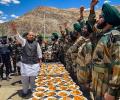
Defence Minister Rajnath Singh on Monday said India is a peace-loving nation that never resorts to any kind of aggression but is always prepared to give a befitting reply if provoked or threatened.
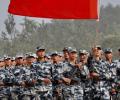
The Chinese action followed 'India's recent, illegal construction of defence facilities across the border into Chinese territory in the Galwan Valley region', a write-up in the state-run Global Times tabloid said, quoting unnamed military sources.

The PM will pay homage to fallen soldiers at the newly-built National War Memorial in New Delhi on the Republic Day instead of Amar Jawan Jyoti beneath the India Gate arch.
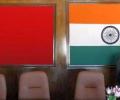
The Indian delegation at Thursday's talks is likely to be led by Naveen Srivastava, Joint Secretary (East Asia) in the external affairs ministry, they said.

Senior commanders of the two armies held intense negotiations for nearly 11 hours on Sunday at a designated meeting point in Moldo on the Chinese side of the Line of Actual Control.
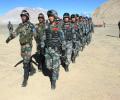
During the course of the intense and complex negotiations between senior commanders of the two armies that ended at 2 am on Wednesday, the Indian delegation also apprised the Chinese PLA about the "red lines" and conveyed that the onus was largely on China to improve the overall situation in the region, the sources said.

On Tuesday, Pompeo and Esper will hold the 2+2 talks with External Affairs Minister S Jaishankar and Defence Minister Rajnath Singh, covering the entire expanse of defence and security ties as well as key regional and global issues.

Lauding the bravery displayed by the soldiers, the prime minister said: "The bravery that you and your compatriots showed, a message has gone to the world about India's strength."
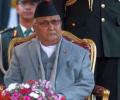
Speaking about the COVID-19 pandemic in Parliament on Tuesday, Oli said it has become very difficult for Nepal to contain the spread of the deadly virus due to the flow of people from outside.

The Chinese military is now desperately attempting to give "ex post facto strategic meaning" to its actions in eastern Ladakh.

Army Spokesperson Colonel Aman Anand said troops from China's People's Liberation Army (PLA) 'violated' the consensus arrived at during military and diplomatic engagements on the ongoing standoff in eastern Ladakh, and carried out provocative military movements to change the status quo.
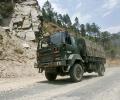
It is learnt that Defence Minister Rajnath Singh has conveyed to top military brass that there was no need for reviewing the implementation of any of the key projects along the Line of Actual Control (LAC) in Ladakh, Sikkim, Uttarakhand or in Arunachal Pradesh in view of the aggressive behaviour by Chinese troops in several sensitive areas.

Oli said the territories belong to Nepal 'but India has made it a disputed area by keeping its Army there'. "Nepalis were blocked from going there after India stationed its Army," he said.

The team of 21 Rashtriya Rifles had entered the house of a civilian to prevent a hostage situation when they came under attack from the terrorists who had already reached there. While the four army personnel and the police Sub Inspector lost their lives in the encounter, the civilians trapped in the house were safely evacuated.
There was no comment from the Indian side on the statement made by the Chinese defence ministry spokesperson Colonel Wu Qian, and carried by China's official media.

He said both sides reaffirmed to sincerely work towards complete disengagement of the troops along the LAC.

Concern is growing among healthcare experts who believe that if people do not follow the lockdown or social distancing seriously, the situation can quickly go out of control.
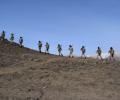
Indian military sources said no firearms were used in the clashes and that most of the injuries were sustained following stone-pelting and use of rods by the Chinese side.
